



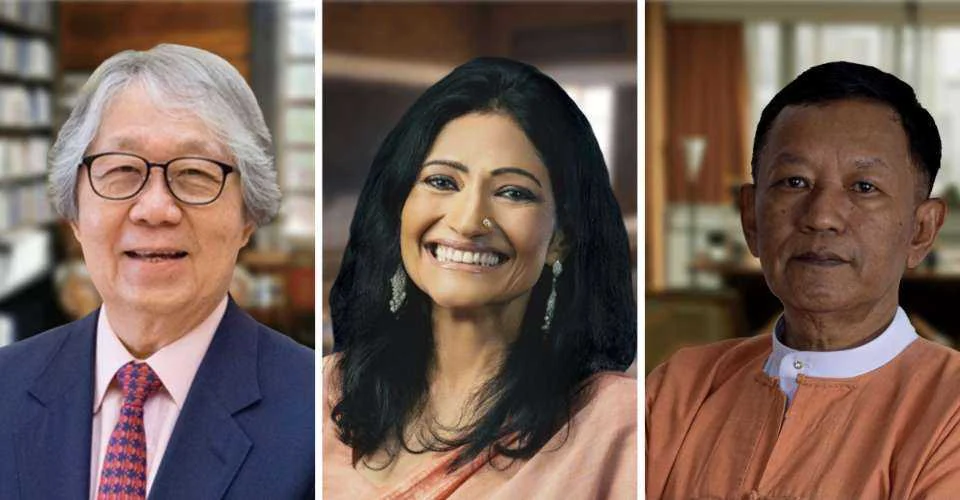
Tommy Koh, Runa Khan and Bo Kyi receive the 2026 Ramon Magsaysay Award, highlighting three approaches to international leadership through diplomacy, humanitarian action and human rights.
The 2026 Ramon Magsaysay Award has recognized three Asian figures whose work has extended well beyond national boundaries: Singaporean diplomat and legal scholar Tommy Koh, Bangladeshi humanitarian and social entrepreneur Runa Khan, and Myanmar human rights advocate Bo Kyi. Their selection reflects a growing understanding of leadership in which international influence is measured not simply by position, but by the ability to create lasting impact for communities and institutions.
The Ramon Magsaysay Award Foundation has long positioned the award as a recognition of service, integrity and “greatness of spirit.” Since its establishment in 1957, the award has honored individuals and organizations from across Asia whose work has contributed meaningfully to society. The 2026 selection adds three distinct models of leadership to that history: diplomacy and international law, humanitarian innovation, and human rights advocacy.
Tommy Koh and the Power of International Diplomacy
Tommy Koh’s recognition carries particular significance for the international community. The Singaporean diplomat, lawyer and academic has spent more than five decades involved in diplomacy, international law and institution building. Among his most notable achievements was his leadership during the Third United Nations Conference on the Law of the Sea, which contributed to the development of the United Nations Convention on the Law of the Sea (UNCLOS).
UNCLOS remains one of the most important international legal frameworks governing the world’s oceans. Its relevance extends across maritime boundaries, navigation, resources and international relations. Koh’s contribution demonstrates how diplomatic negotiations can generate frameworks whose influence continues long after the negotiators themselves have left the negotiating room.
His international experience also includes involvement in the development of ASEAN’s institutional architecture. Koh chaired the High-Level Task Force that drafted the ASEAN Charter in 2007. This background provides a significant regional dimension to his 2026 recognition, particularly as Southeast Asia continues to navigate complex relationships among major global powers.
For companies and institutions operating across borders, Koh’s career offers another lesson: international expansion depends not only on commercial capability but also on an understanding of institutions, law and relationships. Sustainable international engagement requires trust, consistency and the ability to work within diverse political and cultural environments.
Runa Khan: Scaling Humanitarian Solutions
Runa Khan’s path to international recognition is fundamentally different, but equally significant. Through Friendship, the organization she founded in Bangladesh, Khan has developed programs designed to reach communities affected by geographical isolation, river erosion, flooding and climate-related vulnerability.
Friendship’s work encompasses areas including healthcare, education, livelihoods and climate adaptation. Khan’s approach has demonstrated how humanitarian organizations can develop flexible models for populations whose circumstances can change rapidly because of environmental and geographical pressures.
This model has implications for the future of international development. Climate change is creating increasingly complex challenges for governments, development agencies and humanitarian organizations throughout Asia. Traditional service-delivery models may not always work effectively in communities experiencing displacement, changing landscapes or limited access to fixed infrastructure.
Khan’s recognition therefore highlights the potential for locally developed solutions to achieve broader relevance. Her experience demonstrates that international impact does not necessarily begin with a global organization. It can originate from a local response that is subsequently refined, scaled and adapted to other contexts.
Bo Kyi and the International Human Rights Network
Bo Kyi represents a third dimension of international influence: human rights advocacy. A former political prisoner, he co-founded the Assistance Association for Political Prisoners (AAPP) in 2000. The organization has worked to document political imprisonment and provide assistance to prisoners and their families.
The importance of this work has increased significantly following Myanmar’s 2021 military coup. AAPP has continued documenting arrests, detention and other abuses while advocating for individuals affected by political repression.
From an international perspective, documentation is particularly important because it creates a record that can inform journalists, policymakers, researchers and international human rights institutions. In situations where reliable information can be difficult to obtain, civil society organizations can become critical sources of evidence and institutional memory.
Bo Kyi’s recognition consequently illustrates how an organization operating in a difficult domestic environment can develop international relevance. Human rights work increasingly crosses borders through advocacy networks, international institutions and global civil society.
Three Routes to International Recognition
The stories of Koh, Khan and Bo Kyi demonstrate that there is no single formula for international impact. Koh built influence through diplomacy and international institutions. Khan developed scalable humanitarian responses to vulnerable communities. Bo Kyi transformed personal experience and civic commitment into sustained human rights advocacy.
Their achievements also demonstrate an important distinction between visibility and influence. International recognition is not necessarily the result of pursuing publicity. In many cases, global recognition follows years of work addressing concrete problems and building institutions capable of continuing that work.
For organizations seeking international expansion, this provides a useful perspective. Reputation is increasingly connected to purpose, credibility and measurable contribution. Whether in business, government or civil society, organizations that can demonstrate meaningful impact are better positioned to establish durable international relationships.
Asia’s Changing International Reputation
The 2026 Ramon Magsaysay Award also comes at an important moment for Asia. The region is experiencing rapid economic development alongside geopolitical competition, climate pressures, demographic changes and political uncertainty.
Against this backdrop, the three awardees represent areas that will remain strategically important. International diplomacy can help manage geopolitical disagreements. Humanitarian innovation can address the consequences of climate change and displacement. Human rights advocacy can strengthen accountability and preserve attention on communities affected by political crises.
The broader message is that Asia’s international reputation is being shaped not only by governments and corporations, but also by individuals and civil society institutions capable of producing meaningful change.
Building a Legacy Beyond Borders
The formal presentation of the 2026 Ramon Magsaysay Award is scheduled for November 15, 2026, at the Metropolitan Theatre in Manila. The ceremony will formally recognize the three recipients and place their individual achievements within the broader history of the award.
For Tommy Koh, the recognition underscores a lifetime devoted to diplomacy, international law and regional institution building. For Runa Khan, it highlights a humanitarian model designed around communities facing some of Asia’s most difficult environmental challenges. For Bo Kyi, it recognizes sustained advocacy for political prisoners and human rights.
Together, their stories offer a powerful illustration of how Asian leadership can achieve international relevance. Their work began in specific national and local contexts, yet the lessons generated by that work have implications for the wider region and the international community.
The 2026 Ramon Magsaysay Award therefore represents more than a celebration of three individuals. It is also a recognition of three pathways through which Asian leaders can expand their influence: building international institutions, creating adaptable humanitarian solutions, and defending human dignity.
As organizations and leaders increasingly operate in an interconnected world, these examples provide a compelling reminder that international reputation is most durable when it is built on substance. Global influence may begin locally, but lasting recognition comes from the ability to turn commitment into impact that reaches beyond borders.