


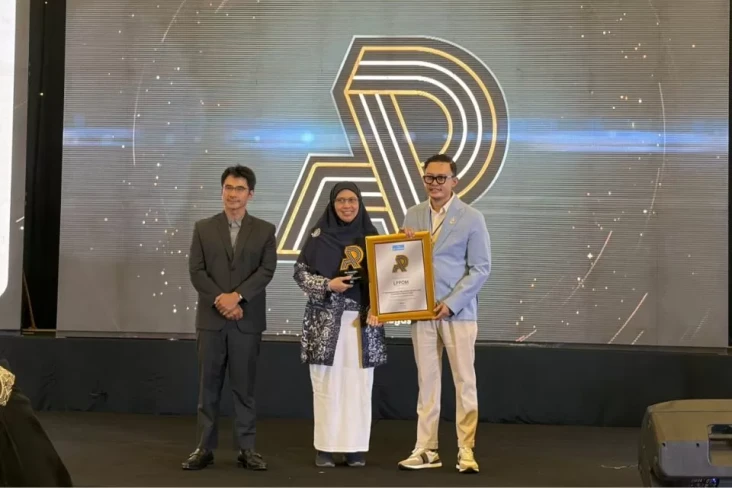
LPPOM’s IPRA 2026 recognition highlights the role of institutional reputation, technical capability and professional standards in strengthening Indonesia’s global halal market position.
Indonesia’s ambition to strengthen its position in the global halal economy depends on more than the growth of domestic demand. It also requires institutions capable of demonstrating professional standards, technical competence and credibility to businesses and consumers across borders.
That institutional dimension was highlighted when LPPOM received recognition at the Indonesia Public Relations Awards (IPRA) 2026 in the Corporate Reputation category for the Non-Governmental Organization sector. The award, organised by The Iconomics Media with support from Axia Research, recognises reputation across business performance, leadership and social contribution.
For LPPOM, the recognition comes as the organisation continues to operate within an increasingly international halal ecosystem. Indonesian companies are looking beyond domestic markets, while global businesses are increasingly interested in Indonesia’s large Muslim consumer base and its broader halal economy.
In this environment, institutional reputation can become an important element of market access.
Reputation as a Competitive Advantage
International expansion requires businesses to overcome one fundamental challenge: trust.
A company entering a new market must demonstrate that its products, processes and claims can be relied upon.
In the halal sector, this challenge becomes particularly important because certification and assurance are directly connected with consumer expectations and regulatory requirements.
A credible inspection and assurance institution can therefore contribute to reducing uncertainty between businesses and markets.
LPPOM’s reputation, built through decades of involvement in halal inspection and certification, provides an institutional asset that can support this process.
Indonesia’s Global Halal Opportunity
Indonesia has a significant opportunity to strengthen its role in the international halal economy.
The country has a large domestic Muslim market, a broad manufacturing base and an increasingly sophisticated ecosystem of halal-related businesses.
The opportunity extends across food and beverages, pharmaceuticals, cosmetics, hospitality, logistics and other industries.
For companies in these sectors, halal assurance can become part of a broader international market strategy.
A trusted certification and testing ecosystem can make it easier for businesses to demonstrate compliance and communicate product attributes to potential consumers and business partners.
Technical Capability Behind International Credibility
Global reputation requires technical substance.
LPPOM’s laboratory infrastructure provides an example of this approach. The organisation operates a laboratory that states it is accredited to SNI ISO/IEC 17025:2017 by Indonesia’s National Accreditation Committee. Its services include chemical, microbiological and molecular testing. (lablppom.com)
The laboratory also provides specialised testing related to halal requirements, including DNA-based analysis.
This technical capability is strategically important because international business relationships increasingly depend on verifiable standards.
For an institution seeking credibility beyond its domestic market, technical accreditation can provide an important foundation.
Supporting International Businesses
LPPOM’s laboratory services are not limited to domestic SMEs.
Its official platform states that it serves both SMEs and multinational companies across industries such as food and beverages, cosmetics, pharmaceuticals, hospitality, restaurants, packaging and distribution. (lablppom.com)
This is relevant to Indonesia’s internationalisation strategy.
Multinational companies operating in Indonesia need to understand local requirements, while Indonesian businesses seeking to export need to understand the expectations of overseas markets.
Professional testing and consultation can help bridge those requirements.
The Supply-Chain Challenge
Global expansion also means dealing with increasingly complex supply chains.
A finished product may contain ingredients sourced from multiple countries. Manufacturing may take place in several locations, while packaging and distribution can involve additional suppliers.
This creates challenges for halal assurance.
Institutions must be capable of assessing not only the final product but also relevant materials and processes.
LPPOM’s laboratory services covering chemical, microbiological and molecular testing are part of the technical infrastructure required to address such complexity. (lablppom.com)
The broader lesson is that international reputation must be supported by systems capable of handling international supply chains.
From Certification to Market Strategy
For businesses, halal certification should not necessarily be viewed only as a compliance exercise.
In markets with significant Muslim populations, credible halal assurance can become a commercial differentiator.
It can support consumer confidence, strengthen brand positioning and facilitate relationships with distributors or business partners.
This is especially relevant for Indonesian companies seeking opportunities in Southeast Asia, the Middle East and other markets where halal considerations are commercially significant.
A credible institutional ecosystem can therefore become part of the country’s broader export infrastructure.
ASEAN as a Strategic Gateway
Southeast Asia provides an important regional opportunity.
ASEAN contains some of the world’s most significant Muslim consumer markets while also serving as a major manufacturing and trade hub.
For Indonesian companies, regional expansion offers opportunities to build scale before moving into more distant international markets.
However, cross-border expansion also requires businesses to understand the regulatory and certification requirements of individual markets.
Institutional cooperation and recognition of credible standards can help reduce friction.
LPPOM’s experience provides Indonesia with an institutional asset as the country seeks deeper engagement with the regional halal economy.
Reputation and International Communications
International reputation also depends on how organisations communicate.
Technical standards can be difficult for consumers and businesses to understand without effective communication.
An institution therefore needs to explain its processes, capabilities and value proposition clearly.
The IPRA recognition demonstrates that reputation and communication are closely connected.
But the more important point is that communication must remain aligned with actual organisational capabilities.
International stakeholders can quickly test claims through independent information, business experience and market feedback.
Leadership as a Reputation Multiplier
Leadership plays an important role in maintaining institutional credibility.
Under Director President Muti Arintawati, LPPOM has continued to emphasise professional competence, service quality and stakeholder engagement.
For organisations seeking international recognition, leadership must be able to maintain established standards while encouraging innovation.
This balance is particularly important in the halal industry, where technological development, new products and international supply chains continue to change the operating environment.
Digital Infrastructure and Global Access
Digitalisation is also changing the way institutions interact with international clients.
Online services can reduce geographical barriers, allowing businesses to access information, submit requests and communicate with technical teams without relying entirely on physical interactions.
LPPOM’s laboratory platform provides online access to several testing-related services and technical information. (lablppom.com)
For international clients, this type of infrastructure can improve accessibility and responsiveness.
However, digital convenience must be supported by robust technical systems and reliable customer service.
International Standards Matter
Global expansion requires alignment with recognised technical standards.
LPPOM’s ISO/IEC 17025 accreditation is relevant because it provides a framework for demonstrating laboratory competence.
The organisation states that its laboratory has maintained accreditation since 2016 and has expanded its capabilities to support physical, chemical and microbiological testing, including services for international clients. (lablppom.com)
This is an important component of institutional credibility.
For international partners, the ability to demonstrate technical competence can be just as important as public reputation.
Building a Trusted Indonesian Brand
Indonesia’s global halal ambitions ultimately require the country to build more than product brands.
It also needs trusted institutions behind those brands.
Halal inspection bodies, laboratories, regulators and professional organisations all contribute to the credibility of Indonesian products.
In this sense, LPPOM’s reputation has implications beyond the organisation itself.
Its credibility can contribute to the broader perception of Indonesia’s halal assurance infrastructure.
That can become increasingly important as Indonesian companies pursue international markets.
The Next Stage of Expansion
The international halal economy will become more competitive.
Countries and companies are investing in halal products, services, certification systems and supporting infrastructure.
Indonesia therefore needs to strengthen its competitive advantage through quality, professionalism, innovation and institutional credibility.
LPPOM’s IPRA 2026 recognition provides one indication that reputation is becoming an increasingly strategic component of this process.
But maintaining that reputation will require continued investment.
Conclusion
LPPOM’s recognition at the Indonesia Public Relations Awards 2026 comes at an important moment for Indonesia’s global halal ambitions.
The award highlights reputation, but the deeper strategic issue is credibility.
International expansion requires trusted institutions, recognised technical standards and reliable assurance systems.
LPPOM’s laboratory capabilities, including ISO/IEC 17025 accreditation and specialised testing services, provide part of that foundation. (lablppom.com)
For Indonesian businesses seeking to expand internationally, such institutional infrastructure can help transform halal compliance from a regulatory requirement into a potential market advantage.
As global halal markets continue to develop, reputation will increasingly become a competitive asset.
For Indonesia, the challenge is to ensure that the institutions supporting its halal economy remain credible, innovative and internationally relevant.
LPPOM’s latest recognition is therefore not simply an award for reputation.
It is a reminder that global expansion begins with trust.
Sources
SINDOnews — Reputasi dan Kepercayaan Jadi Fondasi Penting bagi Organisasi