


FEB UM’s recognition at INSYMA 2025 in Vietnam strengthens its international academic visibility while opening opportunities for research and institutional collaboration.
MALANG, Indonesia — International reputation in higher education is built gradually through research quality, academic networks, institutional engagement and the ability to bring locally grounded knowledge into global discussions. For the Faculty of Economics and Business at Universitas Negeri Malang (FEB UM), recent recognition in Vietnam has added another chapter to that international journey.
FEB UM participated in the 22nd International Symposium on Management (INSYMA) 2025, held in Ho Chi Minh City from 12 to 15 May 2025. The international forum brought together academics and practitioners to exchange research and perspectives on contemporary management and business issues.
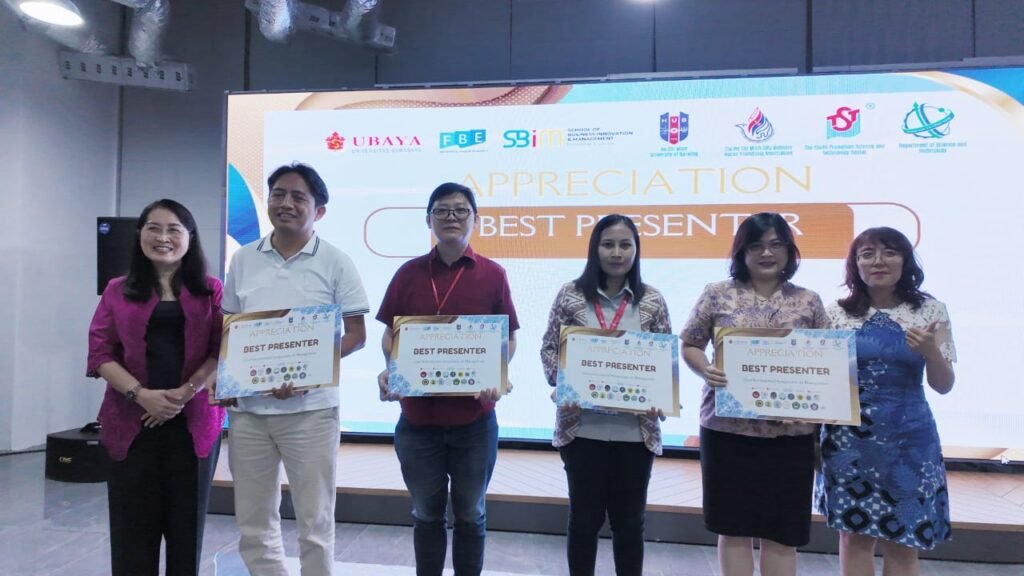
The FEB UM delegation achieved several recognitions during the symposium. Master’s students Lili Purwanitasari and Yohanes Wibisono received Best Presenter awards, while professor Wahjoedi, M.E. received two Best Paper awards.
The achievement provides a visible example of how individual academic performance can contribute to the broader reputation of an institution. In an increasingly interconnected higher education environment, international visibility is influenced not only by institutional rankings but also by the quality and reach of research produced by students and faculty members.
Lili Purwanitasari presented research examining green marketing and its role in driving the circular economy. Her study used a systematic literature review and bibliometric insights from Scopus to examine the development of research in the field.
The subject gives the research an international dimension. Sustainability has become a major issue across markets, and businesses in different countries are increasingly examining how environmental considerations can be incorporated into products, marketing and broader business strategies.
Meanwhile, Yohanes Wibisono presented research on flexible work arrangements, job autonomy, work engagement and employee performance. The subject reflects changes taking place in organisations as businesses adapt to new workplace structures and the increasing use of digital communication technologies.
Such research can provide opportunities for international dialogue because workplace transformation is not limited to one national market. Organisations across Asia and other regions are dealing with questions surrounding productivity, employee autonomy, engagement and management practices.
Wahjoedi’s research introduced another dimension through a study on training effectiveness, diversification and digitalisation among butterfly pea flower MSMEs in Tuban, Indonesia.
The research provides an example of how local economic experiences can become part of an international academic discussion. Indonesia’s MSMEs operate in a diverse economic environment, and research into their digitalisation and diversification can offer insights that may also be relevant to other emerging markets.
From an institutional perspective, bringing such research to an international forum can contribute to the development of academic networks. Presentations create opportunities for researchers to interact with peers, receive feedback, identify common research interests and potentially establish future collaboration.
INSYMA’s 22nd edition itself was centred on the theme “Leveraging AI to Build Competitive Advantage in Financial Industries.” The theme placed technological transformation at the centre of the management discussion and reflected the growing importance of artificial intelligence within financial and business ecosystems.
For FEB UM, participation in a forum addressing such global issues allows its researchers to position their work within a wider international conversation. This is particularly relevant for universities seeking to strengthen international partnerships and increase the global exposure of their academic communities.
International recognition also creates a platform for students. Receiving a Best Presenter award requires more than completing a research project; students must communicate their findings clearly to an audience with diverse academic and cultural backgrounds.
That experience can contribute to the development of researchers and professionals who are comfortable operating in international environments. In the long term, such exposure can become part of an institution’s broader strategy for developing globally oriented graduates.
At the institutional level, reputation is closely connected to consistency. A single international award does not by itself define a university’s global standing. However, participation in international forums, publication, research collaboration and sustained academic engagement can collectively contribute to a university’s international profile.
The FEB UM experience in Vietnam therefore represents more than an award ceremony. It demonstrates how students and faculty members can act as representatives of an academic institution while introducing Indonesian research and perspectives to a wider professional community.
As higher education becomes increasingly global, the ability to establish meaningful international connections will remain important. For institutions such as FEB UM, international conferences provide one avenue through which research, talent and institutional networks can move beyond national boundaries.
The recognition received in Vietnam can consequently be viewed as part of a broader process of internationalisation—one in which academic quality, research relevance and cross-border collaboration become interconnected elements of institutional development.