



Plaza Seremoni IKN’s international recognition at MLAA 2026 strengthens Nusantara’s reputation as a future city focused on design quality, sustainability and global standards.
NUSANTARA — International recognition can play an important role in shaping how a new city is perceived beyond its national borders. For Indonesia’s Nusantara, the Honour Award received by Plaza Seremoni at the Malaysia Landscape Architecture Awards (MLAA) 2026 provides another opportunity to demonstrate the design philosophy and development standards being applied to the new capital.
The award was presented in the Landscape Design Award, Professional Category for International Projects. The official MLAA 2026 winners list records Plaza Seremoni, Nusantara, Indonesia, among the projects receiving an Honour Award, alongside landscape projects from Singapore, Thailand and the Netherlands.
For a city still undergoing development, recognition from an international professional platform can become part of a broader reputation-building process. It provides an external reference for communicating the quality of a project to professional communities, potential partners, investors, visitors and other stakeholders who may not yet be familiar with Nusantara.
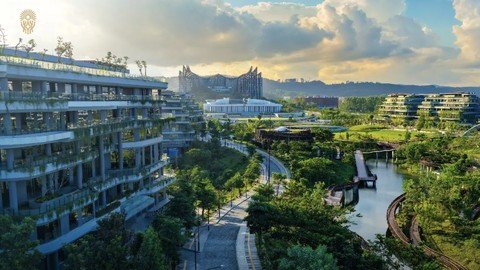
The significance of Plaza Seremoni extends beyond its visual appearance. According to the Nusantara Capital Authority, the project combines aesthetic considerations, public-space functions and sustainable development principles. It is positioned in front of the State Palace and Garuda Palace as part of the Sumbu Kebangsaan area.
The space itself has been designed with multiple public functions, including an open-air amphitheatre, pedestrian and cycling paths, green areas, an MSME gallery and communal spaces. This combination gives Plaza Seremoni a role that goes beyond ceremonial activities and connects the formal identity of the capital with everyday public interaction.
From an international reputation perspective, this distinction is relevant. A city’s image is increasingly shaped not only by landmark buildings, but also by the quality of its public spaces and the experience they provide. In this context, landscape architecture can become part of a city’s identity and international positioning.
Basuki Hadimuljono, Head of the Nusantara Capital Authority, has emphasized three principles underlying the development of Nusantara: quality, aesthetics and sustainability. The principles provide a framework for communicating the direction of the new capital while establishing standards for the projects being developed within it.
The environmental dimension is particularly important to Nusantara’s positioning. The Plaza Seremoni design takes into account the natural contours of the site and existing water-management systems. The approach is intended to maintain environmental balance while strengthening the identity of Nusantara as a city designed in harmony with its natural setting.
This direction is also consistent with the broader forest-city concept associated with Nusantara. Rather than treating greenery as an ornamental addition, the development approach seeks to integrate ecological functions into the urban environment. Such principles can contribute to the way the city communicates its long-term development vision to an international audience.
The MLAA recognition also places Plaza Seremoni within a professional landscape architecture network that extends across borders. The 2026 international category included projects from several Asian cities, creating a regional context in which different approaches to landscape design, environmental sensitivity and user needs are assessed.
For Indonesia, this creates an additional avenue to showcase domestic urban-development capabilities internationally. Recognition does not by itself determine the long-term success of a city, but it can provide a credible reference point when communicating the quality and aspirations of a developing project.
Reputation, however, must ultimately be supported by performance. As Nusantara continues to grow, the durability of its infrastructure, accessibility of public spaces, environmental management, maintenance standards and everyday user experience will contribute to whether the initial international recognition develops into a sustained reputation.
That makes Plaza Seremoni part of a larger strategic narrative. Its award provides an opportunity to communicate that Nusantara is not being developed solely as a collection of government buildings, but as a city where architecture, landscape, public life and environmental considerations are intended to operate together.
For international stakeholders, the development of Nusantara therefore offers a case to observe over the coming years. Its reputation will be shaped through a combination of design achievements, implementation, governance and the actual experience of people who live, work and visit there.
The MLAA 2026 Honour Award is one chapter in that process. More importantly, it demonstrates how individual projects within a new capital can contribute to a broader international identity—an identity that will ultimately be measured not only by recognition, but by the quality and sustainability of the city that Nusantara becomes.