



Wafiq Alni Dzulhijjah’s international award for Sigupai rice husk research highlights the global potential of local-resource innovation and sustainable technology.
A research initiative rooted in one of Indonesia’s local agricultural resources is gaining visibility beyond its regional origins.
Wafiq Alni Dzulhijjah, a doctoral researcher from Universitas Syiah Kuala, has received international recognition for research exploring the potential of Sigupai rice husk as a source of advanced materials and technology for environmental applications.
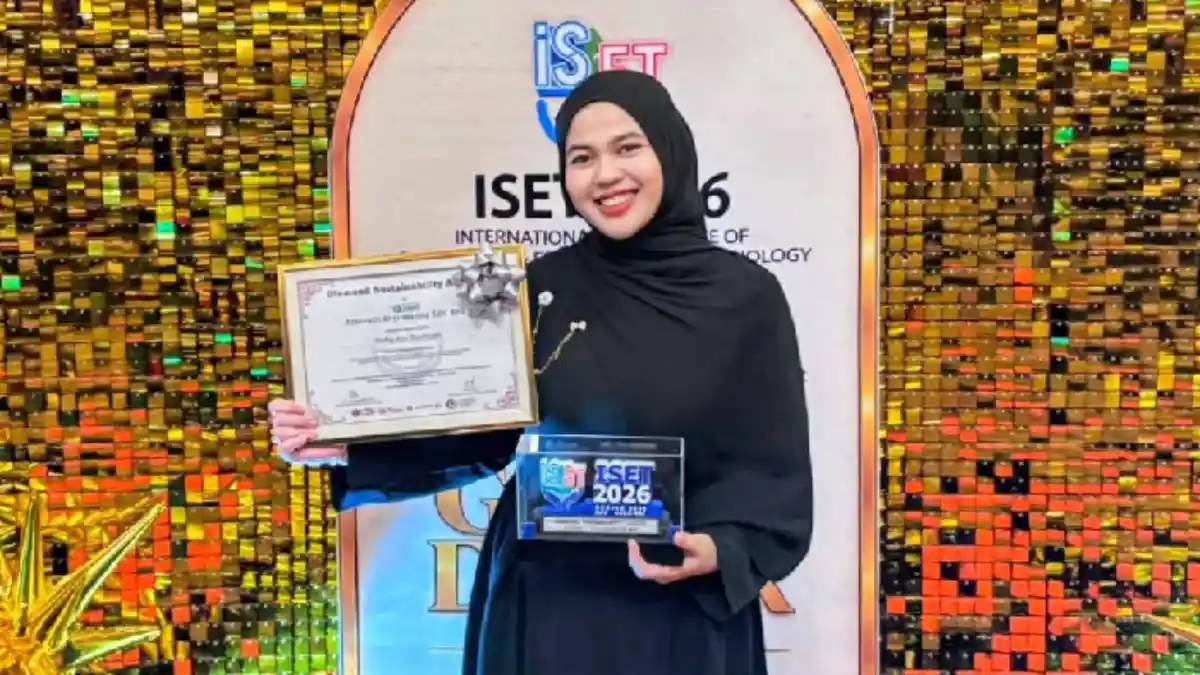
The recognition came at the International Conference of Sustainable and Environmental Technology 2026 (ISET 2026) in Johor Bahru, Malaysia, where Wafiq received the Diamond Sustainability Award 2026. The conference took place from 22 to 24 September 2026 and brought together research related to sustainable and environmental technology.
For Wafiq, the recognition represents an important international milestone. For the research itself, it provides greater visibility for an approach that begins with a relatively simple premise: agricultural waste can potentially become a valuable resource for advanced technology.
Turning a Local Resource into a Research Asset
Sigupai is a local rice variety associated with Aceh. Its rice husk, like other agricultural residues, can easily be viewed primarily as a by-product of rice production.
Scientific research offers a different perspective.
Rather than treating the husk solely as waste, researchers have investigated its chemical and material characteristics and explored pathways for converting it into higher-value materials.
One study published in Case Studies in Chemical and Environmental Engineering examined the synthesis and characterization of nanosilica from Sigupai rice husk waste. The research demonstrates the potential of this particular agricultural residue as a feedstock for nanosilica production.
The research direction has subsequently expanded toward nanocellulose, another advanced material that can be produced from biomass. Studies involving Sigupai rice husk have investigated extraction through acid hydrolysis and the characteristics of the resulting nanocellulose.
Together, these studies illustrate how one agricultural residue can become the starting point for several research pathways in materials science.
Connecting Materials Research with Water Technology
The relevance of the research becomes even broader when the materials are considered in connection with membrane technology.
Wafiq’s research interests include membrane technology, water purification and water and wastewater treatment. Her academic profile reflects a research direction that connects material development with environmental engineering.
Research involving rice-husk-derived nanosilica and nanocellulose has explored their use as antifouling agents in thin-film nanocomposite membranes.
Membrane fouling is an important technical consideration in membrane-based water treatment because the accumulation of unwanted substances on membrane surfaces can affect system performance.
Developing materials that can improve membrane characteristics therefore represents one possible pathway toward more effective treatment technologies.
The research remains part of a scientific development process, but the connection between agricultural waste, advanced materials and water technology provides a clear example of how different disciplines can intersect.
Why International Recognition Matters
An international award does not by itself determine whether a research concept will become commercially successful. However, recognition at an international scientific forum can provide visibility for researchers and their work.
For researchers working with locally sourced materials, international exposure can create opportunities to exchange findings with researchers from other countries, identify complementary expertise and explore potential collaborative research.
In Wafiq’s case, the recognition in Malaysia places research originating from Aceh within a broader international setting.
That distinction is important. The research is not presented simply as a regional agricultural story. It is part of an international scientific discussion about sustainable materials, environmental engineering and resource efficiency.
For developing research ecosystems, international visibility can also contribute to institutional reputation. Publications, conference presentations, scientific collaborations and awards can collectively increase awareness of research capabilities within universities and research communities.
The Opportunity for Cross-Border Collaboration
The next phase of innovation often requires collaboration beyond the original research environment.
Advanced materials research can involve chemistry, materials characterization, engineering, environmental science, process development and application testing. Few research groups operate at full capacity across every one of these areas.
International collaboration can therefore become an important mechanism for expanding research capabilities.
For a material derived from local agricultural waste, collaboration may involve comparing feedstocks from different regions, developing standardized processing methods, conducting additional performance testing or evaluating environmental and economic implications.
In Southeast Asia, such cooperation can be particularly relevant because many countries share agricultural resources, environmental challenges and interests in developing circular-economy models.
The Sigupai research provides a potential starting point for that kind of dialogue without suggesting that commercial or industrial deployment has already been achieved.
From Recognition to Responsible Scale-Up
One of the most important stages after promising laboratory research is determining whether the process can be scaled responsibly.
A material that performs well under controlled laboratory conditions may face different challenges when production volumes increase.
Raw-material consistency, processing requirements, energy consumption, chemical use, equipment requirements and quality control can all influence the feasibility of a larger-scale process.
Economic considerations are equally important. A sustainable technology needs to be assessed not only for technical performance but also for its overall cost structure and environmental footprint.
These questions are particularly relevant for agricultural-waste-based technologies because feedstock availability can vary according to location, season, farming practices and collection systems.
Consequently, the future development of Sigupai-based materials will require continued research and validation before broader applications can be assessed.
Local Roots, International Visibility
The international journey of Wafiq’s research also carries a broader message about the relationship between local resources and global innovation.
Innovation does not always begin with materials developed specifically for high-tech industries. Sometimes it starts with a resource that has existed for generations and is then reconsidered through the lens of modern science.
In the case of Sigupai rice husk, the research moves through several stages: agricultural residue, material characterization, nanoscale processing, advanced-material development and potential environmental applications.
Each stage adds scientific knowledge and opens another question about what the material might eventually contribute to.
This is one reason international recognition can be meaningful even before a technology reaches large-scale deployment. It places the research within a wider network where future questions, partnerships and applications can be explored.
Building an International Research Reputation
For researchers, international reputation is generally built over time.
A single award can provide visibility, but sustained recognition depends on the broader body of research, scientific publications, collaborations, presentations and measurable contributions to the field.
Wafiq’s work on Sigupai rice husk forms part of that continuing research journey.
Her research demonstrates how a local resource can become the subject of studies involving nanosilica, nanocellulose and membrane technology. The international recognition in Malaysia adds another chapter to that journey.
The broader opportunity lies in connecting this research with researchers and institutions working on related questions elsewhere.
Such connections could eventually support comparative studies, technology development, further publications or new applications—although each possibility would depend on future research and collaboration.
A Research Story with Global Potential
The significance of the Sigupai research lies in its ability to connect several global priorities at once: agricultural waste reduction, resource efficiency, advanced materials and environmental technology.
It also demonstrates the importance of looking beyond conventional definitions of raw materials.
For countries with substantial agricultural production, residues can represent an underexplored resource base. The challenge is to determine which materials have genuine technical value and whether they can be processed in ways that are environmentally and economically responsible.
Wafiq’s recognition at ISET 2026 brings international attention to one such research pathway.
From Aceh to Malaysia, the story shows how research built around a local agricultural resource can enter international scientific conversations.
The next chapter will depend on continued research, validation and collaboration. But the foundation is already significant: a locally sourced material has become the subject of advanced scientific research and has received recognition on an international stage.
That combination of local roots and international visibility is what gives the Sigupai research a place in the evolving global conversation about sustainable innovation.