



Mohammed Al-Issa’s Dato Sri honor from Malaysia became part of a wider international leadership journey spanning religious diplomacy, global partnerships and cross-cultural dialogue.
The international profile of Sheikh Dr. Mohammed bin Abdulkarim Al-Issa has been shaped not only by the positions he has held, but also by the network of international relationships developed through his work with the Muslim World League (MWL).
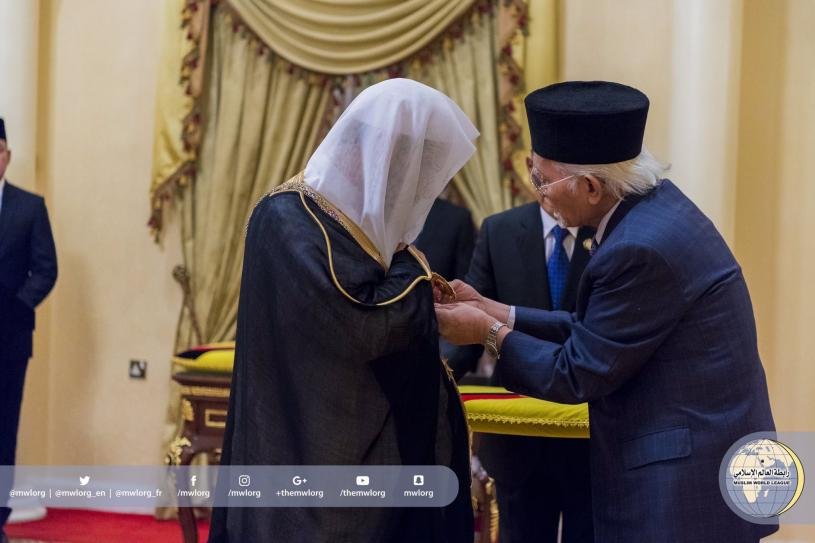
One of the early milestones in that trajectory came in April 2017, when the Kingdom of Malaysia conferred its highest honorary title, Dato Sri, on Al-Issa. The ceremony was convened by the Sultan of Malaysia, with the honor recognizing his efforts to promote moderation. At the time, Al-Issa had been serving as Secretary-General of the MWL since August 2016.
The Malaysian recognition became one element in a growing record of international engagements. MWL’s official timeline lists subsequent recognitions and institutional engagements involving countries and organizations across Europe, Asia, Africa and the Americas. Among them are the Galileo European Renaissance Pioneers Award in Italy in 2018, an honorary recognition from Universiti Malaya in 2024, and senior-level engagements in Pakistan, Guinea-Bissau, the United States and other countries.
For an international organization, such a network is strategically significant because reputation is built through sustained relationships rather than a single event. Meetings with government leaders, religious institutions, universities and international organizations provide multiple channels through which an institution can communicate its priorities and establish opportunities for cooperation.
The MWL describes Al-Issa’s international mission in terms of peacebuilding, humanitarian engagement, interfaith outreach and the promotion of moderation. Its official platform also highlights religious diplomacy as an important component of engagement with faith leaders, governments and international institutions.
Malaysia has remained an important part of this international network. In April 2026, Malaysian Prime Minister Dato’ Seri Anwar Ibrahim received Al-Issa in Kuala Lumpur. Their meeting covered Islamic and international issues related to the MWL’s mission and objectives, as well as preparations for the Third International Summit of Religious Leaders and the fourth session of the ASEAN Council of Scholars.
The relationship subsequently moved beyond diplomatic meetings toward practical cooperation. Bernama reported in April 2026 that Malaysia and the MWL were preparing several strategic initiatives and collaborations following discussions involving Malaysia’s Minister in the Prime Minister’s Department for Religious Affairs, Dr Zulkifli Hasan, and Al-Issa. The initiatives were described as an effort to translate discussions into future cooperation.
This shift from recognition to institutional cooperation is relevant to international reputation-building. A prestigious honor can establish visibility, but sustained engagement depends on whether relationships can generate continuing dialogue, programs and partnerships.
The June 2026 religious leaders’ summit in Kuala Lumpur provided another example. Al-Issa delivered the opening address at the Third International Summit of Religious Leaders, held under the patronage of Sultan Nazrin Muizzuddin Shah and in the presence of Prime Minister Anwar Ibrahim. His remarks addressed the responsibility of religious leaders in contributing to peace and social harmony, while also highlighting challenges associated with modern technology and artificial intelligence.
The internationalization of the agenda was also visible through the participation of young leaders, university students and researchers from ASEAN countries. The MWL’s summit documentation records meetings between Al-Issa and representatives of the region’s younger academic and leadership communities.
For organizations seeking international expansion, the experience offers a broader lesson about the role of cross-border networks. International visibility is strengthened when institutional relationships extend across government, academia, religious organizations and civil society, creating multiple points of engagement rather than relying on one diplomatic channel.
The evolution of Al-Issa’s relationship with Malaysia illustrates that process. The Dato Sri title in 2017 represented formal recognition of his work in promoting moderation. Years later, Malaysia became a venue for high-level meetings, regional scholarly forums, youth engagement and discussions on future cooperation.
The trajectory also reflects a changing international environment in which religious diplomacy increasingly intersects with public policy, technology, education and social cohesion. The MWL’s recent engagements, including activities in the United States and participation in international institutions, indicate that its network extends well beyond the Middle East and Southeast Asia.
For Al-Issa and the MWL, the challenge moving forward is to maintain the continuity between international visibility and substantive cooperation. Recognition can open doors, while long-term partnerships require sustained programs, institutional credibility and measurable engagement.
The Malaysian honor therefore represents more than an isolated chapter in Al-Issa’s career. It is part of a broader international journey in which personal recognition, institutional diplomacy and cross-border cooperation have developed alongside one another.